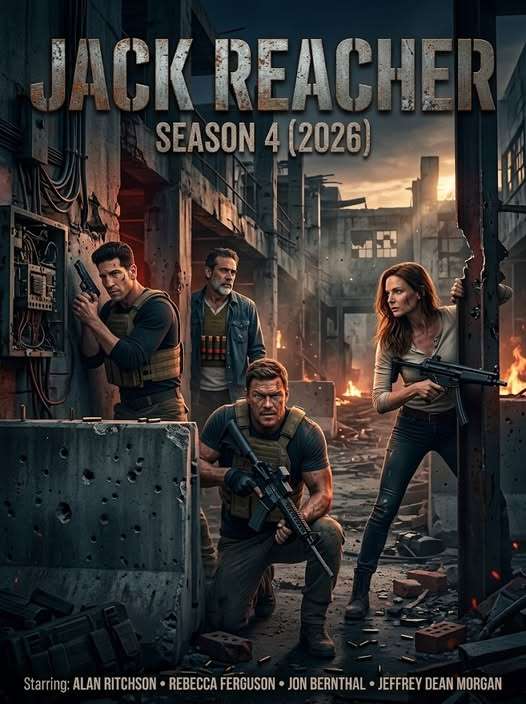
– Jack Reacher Season 4 (2026): Intelligence Warfare Pushes the Franchise Into Darker Territory
Jack Reacher Season 4 arrives with a notable shift in direction, moving beyond physical confrontations and isolated investigations into a broader conflict involving intelligence networks, witness disappearances, and information warfare. Led once again by Alan Ritchson in the title role, the new season positions Reacher against an adversary built not on brute force, but on secrecy, surveillance, and strategic manipulation.
The premise matters because it challenges one of the defining strengths of the character: the ability to solve problems through direct action and personal instinct. This time, those instincts are tested inside a conflict where the enemy prefers to remain invisible.

Key Developments Point Toward a More Complex Threat
According to the season’s central storyline, a shadow organization has begun systematically eliminating witnesses across multiple states. The operation is precise, coordinated, and designed to leave little evidence behind.
That pattern of disappearances eventually attracts the attention of Reacher, who quickly discovers that traditional investigative methods may not be enough to expose an enemy operating through layers of intermediaries and misinformation.
The season introduces a larger cast of allies and adversaries, with Christopher Rodriguez-Marquette, Sydelle Noel, Agnez Mo, Kevin Corrigan, and Marc Blucas joining the ensemble.
Rather than functioning as simple supporting characters, the new additions appear positioned to represent competing interests, conflicting loyalties, and shifting alliances within a rapidly evolving conspiracy.
For a franchise known for straightforward momentum, that complexity represents a significant evolution.
And perhaps an unavoidable one.
As the scale of the threat expands, Reacher himself becomes a target rather than merely an investigator. The hunter-and-hunted dynamic that has defined previous chapters becomes increasingly blurred as intelligence agencies, covert operatives, and criminal networks pursue overlapping objectives.

Background and Context for the Franchise’s Evolution
The modern success of Jack Reacher has largely been built on a clear formula: an outsider arrives in a troubled environment, uncovers corruption, and uses a combination of deductive reasoning and overwhelming physical capability to restore order.
Season 4 appears intent on preserving that formula while testing its limits.
Unlike previous conflicts centered around local corruption, criminal enterprises, or military conspiracies, the new storyline enters the territory of information control and institutional secrecy.
That shift aligns naturally with contemporary thriller storytelling, where digital surveillance, data manipulation, and covert intelligence operations increasingly define modern conflict.
Showrunner Nick Santora appears to be steering the series toward a more neo-noir identity, one where uncertainty becomes as dangerous as violence itself.
Questions become weapons.
Information becomes currency.
And trust becomes increasingly difficult to maintain.
The result is a setting that feels larger than a single town or investigation while still preserving the personal stakes that audiences associate with the Reacher character.

Alan Ritchson Faces a Different Kind of Challenge
Alan Ritchson’s interpretation of Reacher has become one of the defining elements of the series. His performance balances physical presence with dry humor, restraint, and a practical sense of morality that resonates with viewers.
Season 4 offers an opportunity to expand that portrayal.
Facing a hidden intelligence operation requires a different set of tools than confronting criminals in direct combat. Patience, observation, and strategic thinking become equally important alongside physical capability.
The season’s psychological emphasis may allow the character to evolve without abandoning the qualities that made him popular in the first place.
Reacher has always trusted facts more than institutions.
In a world built on misinformation, that philosophy becomes more relevant than ever.
“Justice becomes complicated the moment truth itself becomes contested.”
That idea appears to sit at the center of the season’s narrative ambitions.

Neo-Noir Influences Shape the Tone
The classification of Season 4 as an action thriller with neo-noir elements is particularly notable.
Traditional noir stories often revolve around moral ambiguity, hidden agendas, and protagonists navigating systems designed to conceal the truth. Those themes align naturally with the season’s premise involving witness erasures and covert operations.
Visually and structurally, viewers can likely expect a heavier emphasis on atmosphere, uncertainty, and layered investigations rather than continuous large-scale action sequences.
That does not necessarily mean less action.
Instead, action may become more purposeful and consequential, emerging from investigative breakthroughs rather than serving as the primary engine of the narrative.
The approach has the potential to create stronger tension because every confrontation carries broader implications beyond immediate survival.
What Works — And What Doesn’t
The most promising aspect of Jack Reacher Season 4 is its willingness to evolve.
- A larger conspiracy introduces fresh narrative possibilities.
- The intelligence angle differentiates the season from previous installments.
- The expanded cast creates opportunities for layered character dynamics.
- The neo-noir tone fits naturally with themes of surveillance and deception.
The central concept also aligns with modern audiences who increasingly respond to thrillers built around hidden networks and institutional power.
However, the shift also carries risks.
Part of Reacher’s appeal lies in simplicity: a capable individual confronting obvious wrongdoing with clarity and conviction. A story built around intelligence operations and complex conspiracies could potentially distance the series from that core identity if not handled carefully.
Balancing strategic intrigue with the franchise’s trademark directness will likely determine how successful the season becomes.
Fans are unlikely to object to complexity.
They may object if complexity replaces momentum.
Potential Impact on the Future of the Series
If successful, Season 4 could establish a new template for future stories within the Jack Reacher universe.
The expansion into intelligence conflicts creates opportunities for broader narratives that move beyond regional corruption and isolated incidents.
It also allows the franchise to remain contemporary without abandoning the character’s fundamental principles.
Reacher may be entering a world of algorithms, surveillance systems, and information warfare, but his methods remain rooted in observation, logic, and accountability.
Those qualities continue to separate him from many modern action protagonists.
Technology may change.
Human motives rarely do.
Conclusion
Jack Reacher Season 4 positions the franchise at an important crossroads, introducing intelligence warfare, institutional secrecy, and psychological conflict while retaining the grounded action foundation that audiences expect.
With Alan Ritchson returning alongside an expanded cast and a more ambitious narrative framework, the season aims to explore what happens when a man designed for straightforward justice enters a battlefield defined by misinformation and hidden agendas.
Whether the strategy succeeds will depend on execution, but the direction itself signals confidence in the longevity and adaptability of the franchise.
For Reacher, the greatest threat may no longer be the enemy standing in front of him.
It may be the one that never intended to be seen at all.
Frequently Asked Questions
What is the main storyline of Jack Reacher Season 4?
The season follows Reacher as he investigates a covert operation responsible for eliminating witnesses across multiple states, eventually uncovering a larger intelligence conspiracy.
Who stars in Jack Reacher Season 4?
The cast includes Alan Ritchson, Christopher Rodriguez-Marquette, Sydelle Noel, Agnez Mo, Kevin Corrigan, and Marc Blucas.
Who created and oversees the series?
Jack Reacher Season 4 is led by creator and showrunner Nick Santora.
What genre does Season 4 belong to?
The season combines action thriller storytelling with neo-noir themes involving secrecy, surveillance, and intelligence operations.
How does Season 4 differ from earlier installments?
Unlike previous stories centered on local criminal activity or corruption, Season 4 places Reacher in conflict with organized intelligence networks operating on a much broader scale.